My Research
Far-infrared Follow-up of a UV Bump Galaxy
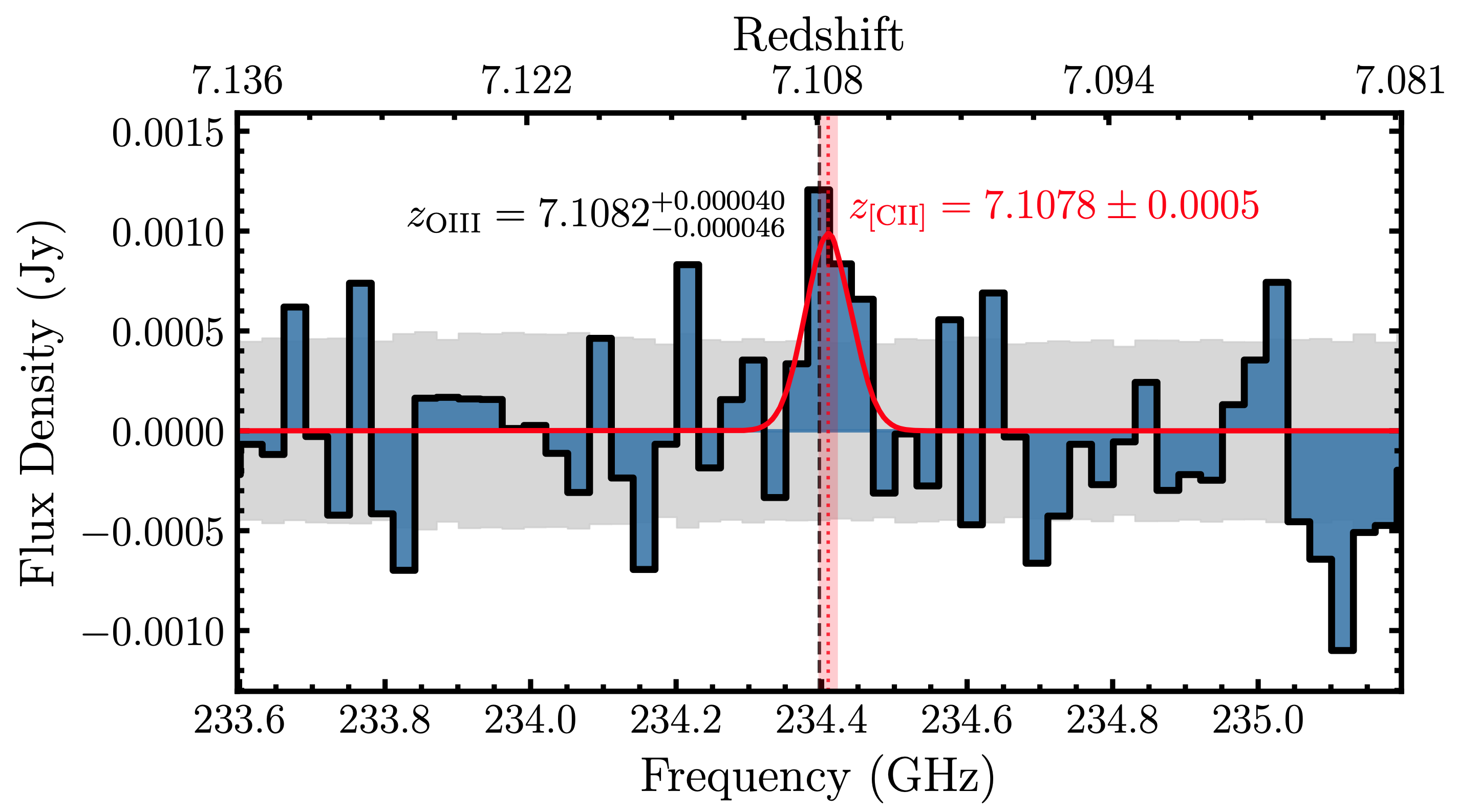
In this paper, we present NOEMA far-infrared observations of the UV bump galaxy GNWY-7379420231 at z=7.1, detecting [C II] 158µm emission whilst the dust continuum remains undetected, ruling out a heavily dust obscured, massive system. Instead, our findings reveal a moderately massive, gas-rich galaxy with a recent burst of star formation, suggesting that efficient grain shattering in the diffuse ISM or favourable line-of-sight alignment are needed to explain the UV bump properties of this galaxy. Find out more →
The 2175Å UV Bump at High Redshift
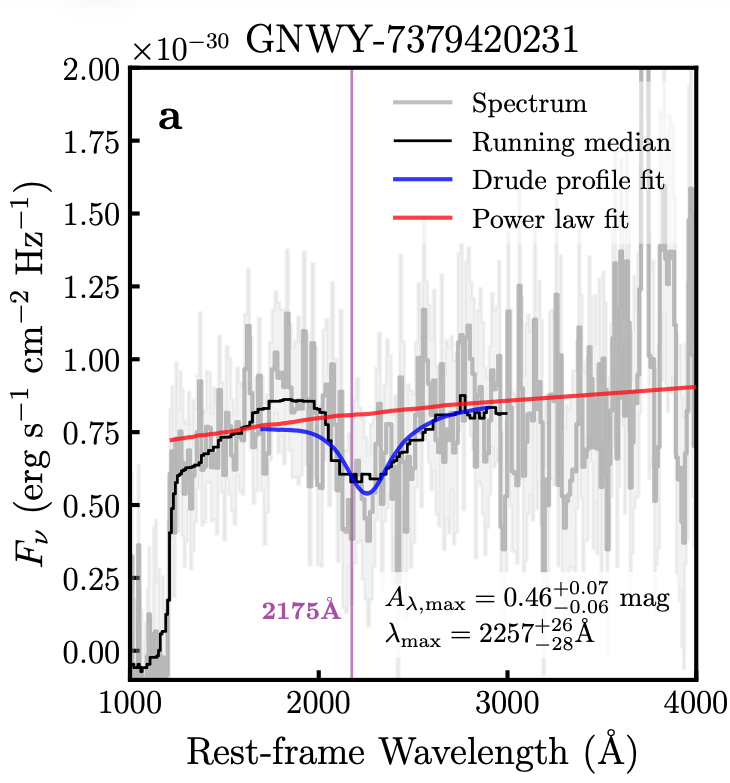
In this paper, we identified a bright galaxy at z=7.1, with a strong 2175Å UV bump
feature in its rest-UV spectrum, through observations taken as part of the NIRSpec
Wide GTO survey.
The presence of the UV bump feature at such early times indicates rapid evolution of
dust properties within the first billion years of cosmic time. To investigate the origin
of the dust responsible for the UV bump, we carried out resolved SED fitting, suggesting
that existing (large) dust grains are likely being rapidly reprocessed in the ISM,
producing the small carbonaceous grains responsible for the UV bump feature.
Find out more →
The Size and Shape Evolution of Galaxies with the James Webb Space Telescope
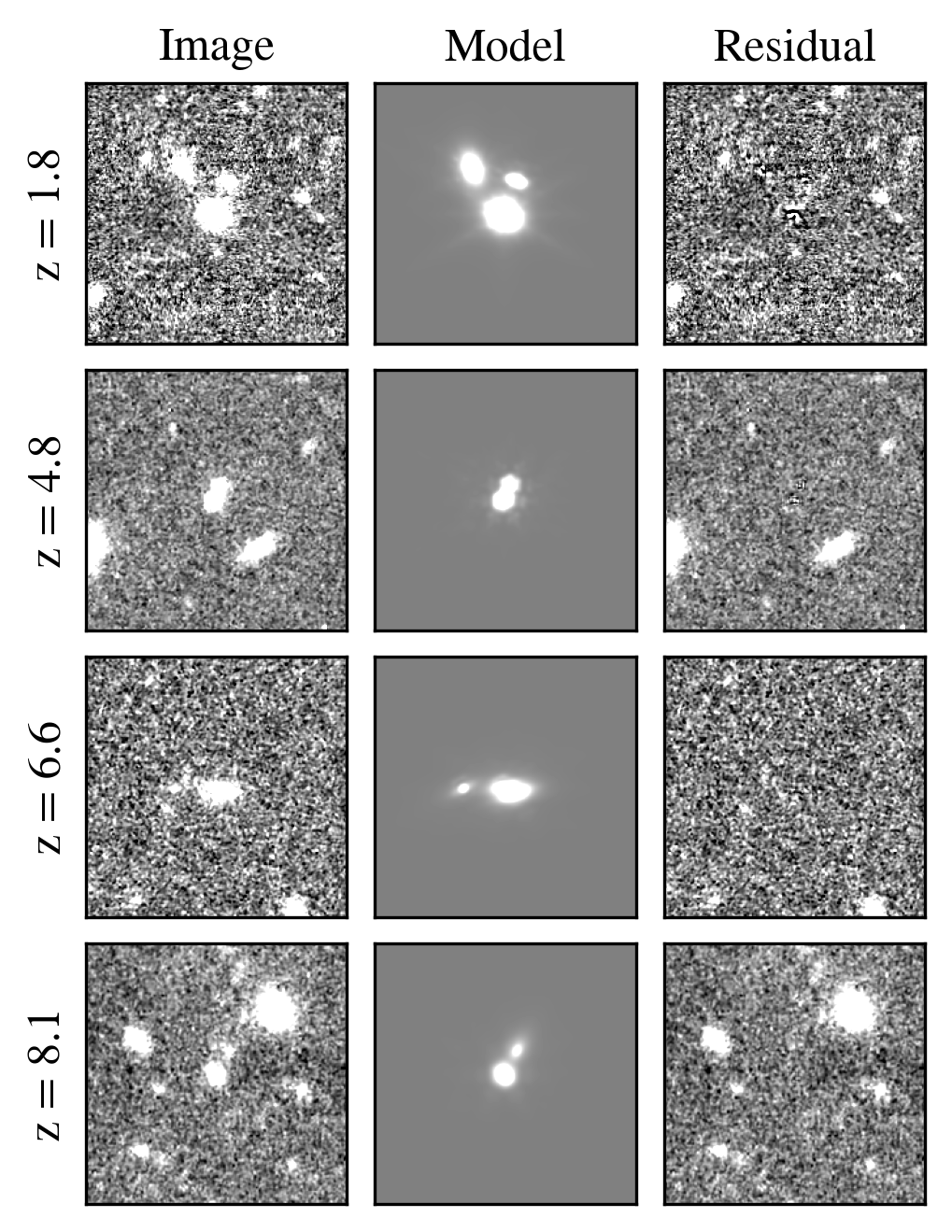
In this paper, we present a morphological analysis of 1395 galaxies at 0.5 ≤ z ≲ 8 with stellar masses
log (M*/M⊙) > 9., using public JWST NIRCam data within the CEERS field, overlapping with the CANDELS EGS
observations. We utilise surface brightness fitting with GALFIT to fit single Sérsic models to the
rest-frame optical profile of galaxies.
We find that galaxies become progressively smaller with increasing redshift, and that the majority of
massive galaxies at high redshift are are described by low Sérsic indices.
Find out more →
Successful Proposals
Constraining Dust Formation at Cosmic Dawn with Luminous UV Bump Galaxies
PI, JWST NIRSpec IFU
Observing time: 19 hours
The 2175Å UV bump as a signpost of NIRCam dark star formation
PI, NOEMA interferometer
Observing time: 25 hours
Unveiling dust build up in a 'UV bump' galaxy at z=7.1 with JWST+NOEMA
Co-PI, NOEMA interferometer
Observing time: 16 hours